The BELL+HOWELL Portable Light Bar review centers on a straightforward role: keeping a rechargeable light ready for outages, utility spaces, and trips where a cordless lamp is useful.
Its automatic outage response and several placement options suit buyers who value convenience, while its dry-condition design calls for care around moisture.
Portable Light Bar Review Summary
The quick verdict
3,000+ ratings
Read Amazon ReviewsBELL+HOWELL Portable Light Bar
A rechargeable backup light for households, campers, and workshop users who want automatic illumination during a power cut and flexible placement.
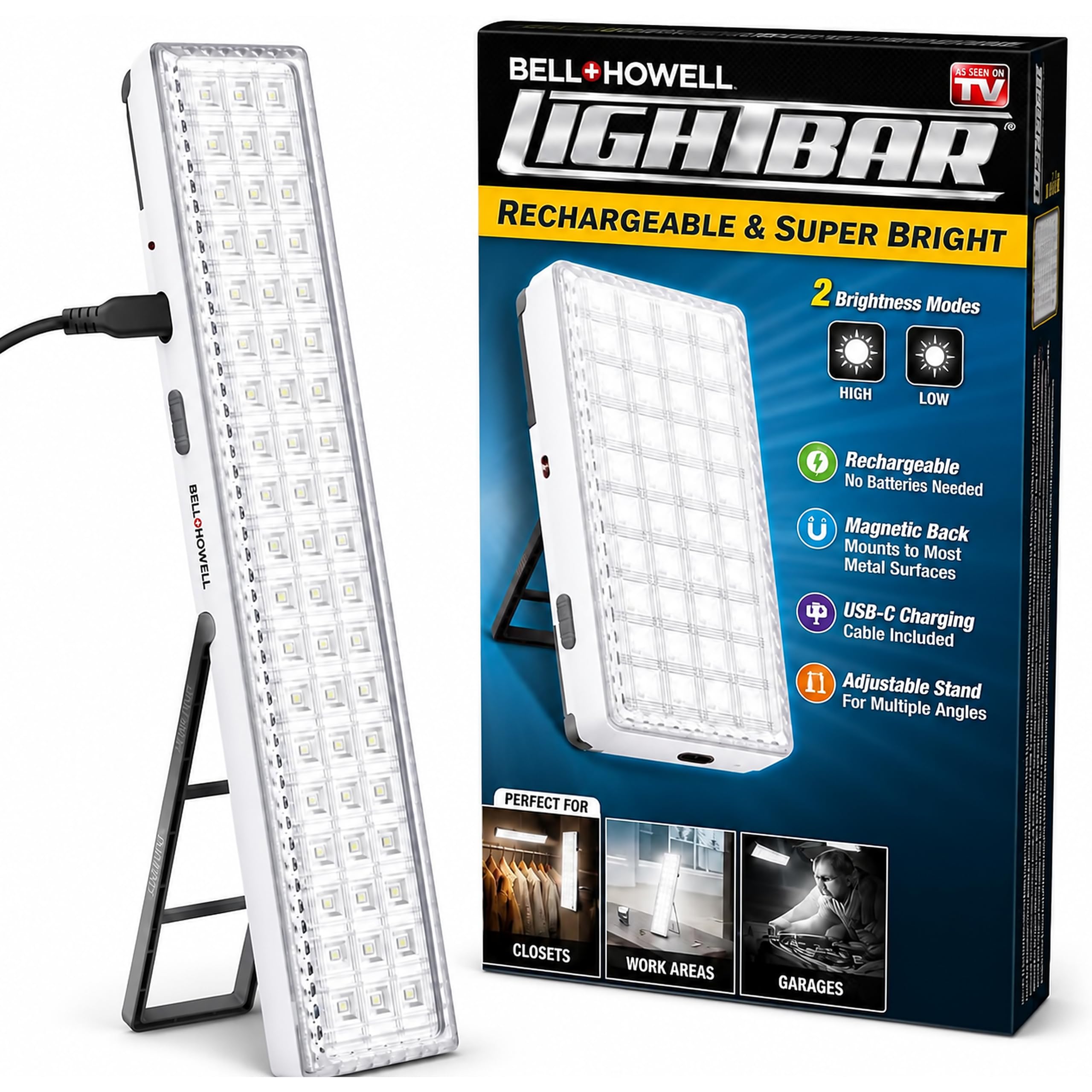
- A 16.5-inch rechargeable light bar with 60 built-in LED bulbs.
- High mode provides up to 720 lumens; a lower brightness mode is intended to use less battery.
- An outage sensor can switch the light on automatically when it is plugged in and household power fails.
- Includes a fold-out stand, a hanger, and an AC charging adapter.

Pros
- Automatic illumination during an outage can make a backup light easier to locate and use.
- Two brightness settings provide a choice between stronger illumination and a lower setting intended to extend battery use.
Consider before buying
- The first charge takes about 24 hours, so it needs advance preparation before relying on it.
- Runtime depends on the selected mode, and the high setting drains the battery faster.
Read the full review summary
This 16.5-inch light bar combines 60 LEDs, two brightness modes, a fold-out stand, and a hanger in a rechargeable design.
Leave it plugged into an outlet with its outage sensor active and it is intended to switch on when household power fails, reducing the need to find a separate flashlight in the dark.
It makes the most sense as a general-purpose backup for a home, garage, shed, tent, or RV, where it can sit on a surface or hang from a hook.
The tradeoffs are its lengthy first charge, the need to recharge it periodically in storage, and the fact that it is not waterproof. Buyers who need a light for wet conditions should choose a different design.
The buying factors
Portable Light Bar Scorecard
Editorial scores reflect listed features and buyer fit; they are not laboratory measurements or customer ratings.
Outage readiness
The active sensor is designed to turn the light on automatically when household power cuts out.
Light output options
Two brightness modes include a high mode rated up to 720 lumens, with a lower setting for softer light and longer battery use.
Placement flexibility
A fold-out stand and hanger give it useful tabletop and suspended placement options.
Cordless usefulness
Battery power supports portable use around a home or at a campsite, though runtime varies by mode.
Setup and upkeep
The controls are simple, but the initial charge takes about 24 hours and stored units need periodic recharging.
Moisture suitability
It is designed for dry conditions and is not waterproof, limiting its usefulness in exposed or wet settings.
Key Features and Specifications of Portable Light Bar
- A 16.5-inch rechargeable light bar with 60 built-in LED bulbs.
- High mode provides up to 720 lumens; a lower brightness mode is intended to use less battery.
- An outage sensor can switch the light on automatically when it is plugged in and household power fails.
- Includes a fold-out stand, a hanger, and an AC charging adapter.
- Push-button control and battery power support use away from an outlet after charging.
- Designed for dry conditions; it is not waterproof.
Pros and Cons of Portable Light Bar
Pros
- Automatic illumination during an outage can make a backup light easier to locate and use.
- Two brightness settings provide a choice between stronger illumination and a lower setting intended to extend battery use.
- The stand and hanger support more than one placement style.
- Its cordless format suits utility areas and travel setups where an outlet may not be nearby during use.
Consider before buying
- The first charge takes about 24 hours, so it needs advance preparation before relying on it.
- Runtime depends on the selected mode, and the high setting drains the battery faster.
- Periodic recharging is recommended during storage.
- It is not waterproof, so it is a poor fit for wet or rain-exposed use.
Who Should Buy Portable Light Bar?
Good fit
Consider it if you want a rechargeable light that can remain plugged in as an outage backup and also move to a closet, garage, basement, or workbench when needed.
The automatic sensor is the key convenience: keep the unit connected and the sensor active if you want it to respond to a household power failure.
It can also suit dry camping or RV use, where the stand or hanger may help position light without needing to hold a flashlight.
Use the lower mode when softer light and battery conservation matter more than maximum output, and plan to recharge it after use or every few months in storage.
Who should skip it
Look elsewhere if you need lighting for rain, damp work areas, or other wet conditions; this light bar is not waterproof.
It may not suit a buyer who needs a specified runtime or expects a fully charged unit immediately. The description gives no fixed runtime, and the initial charge takes about a day.
How the Portable Light Bar Fits Home Backup Use
Automatic outage response
The sensor gives this bar a role beyond an ordinary portable lamp.
It is designed to stay plugged in and turn on when household power fails, so its best use is as a ready backup in a location where it can remain connected.
Buyers should keep the sensor active and choose a spot where the light can illuminate a useful area without being blocked.
Choosing a brightness mode
The high setting reaches up to 720 lumens, while the lower setting is described as softer and more battery-conscious. That gives users a practical choice between brighter general illumination and a setting intended to stretch the charge.
Since runtime depends on mode, buyers who expect a long outage should consider which setting will meet the room's needs rather than defaulting to high.
Placement around the home
The folding stand and hanger make the light adaptable to tables, shelves, and hooks. That is useful in spaces where a ceiling fixture is unavailable or where a portable lamp needs to move between tasks.
Consider where the unit will sit or hang before an outage, since its placement will determine how much of the surrounding area it can illuminate.
Charging and storage routine
The unit needs about 24 hours of charging before first use, and periodic recharging every few months is recommended if it is stored.
This favors a planned backup routine: charge it ahead of storm season or travel, then maintain its charge during storage. Keep expectations flexible because the available description does not give a fixed runtime for either mode.
Alternatives to Portable Light Bar
No alternative model is recommended here. Compare the placement, brightness options, and moisture suitability that matter to your routine before choosing another light.
Is Portable Light Bar Worth It?
The BELL+HOWELL Portable Light Bar is worth considering as a dry-location backup for households that want a rechargeable light with an automatic outage response. Its two modes and stand-and-hanger setup add everyday utility beyond emergency use.
Buy it if you can keep it charged and use it in dry spaces; skip it for wet environments or if you need a guaranteed runtime.
Its most appealing feature is readiness when left plugged in, while its main ownership consideration is maintaining that charge.
Your review at a glance
3,000+ ratings
Read Amazon ReviewsBELL+HOWELL Portable Light Bar
A rechargeable backup light for households, campers, and workshop users who want automatic illumination during a power cut and flexible placement.
- A 16.5-inch rechargeable light bar with 60 built-in LED bulbs.
- High mode provides up to 720 lumens; a lower brightness mode is intended to use less battery.
- An outage sensor can switch the light on automatically when it is plugged in and household power fails.
- Includes a fold-out stand, a hanger, and an AC charging adapter.